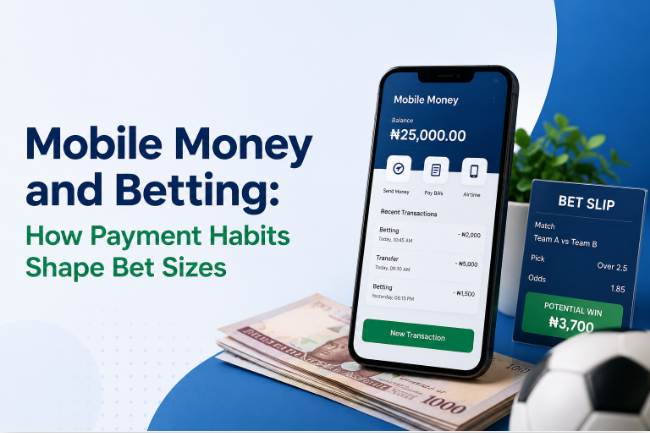
Mobile money has quietly become one of the biggest forces shaping how football fans bet. It’s not just a payment method – it changes how quickly people stake, how much they stake, and how easily they can walk away from a losing position. Anyone who follows Premier League weekends or Champions League nights closely has probably noticed that the way people pay matters almost as much as the odds they’re chasing.
This piece looks at the mobile money and betting relationship from a practical, football-first angle: what patterns tend to show up, why they happen, and how understanding them can make you a more disciplined bettor.
Why Payment Method Changes Betting Behavior
Every payment method carries a bit of psychological friction – or the lack of it. A bank transfer usually takes a few extra steps: logging into an app, confirming details, sometimes waiting for a transaction to clear. Mobile money, by contrast, is built for speed. A stake can be placed and confirmed in seconds, often without leaving the betting platform’s interface at all.
That speed is convenient, but convenience cuts both ways. Behavioral researchers who study spending habits generally agree that reducing the “steps” between wanting to spend and actually spending tends to increase both frequency and average spend. Betting isn’t exempt from this. When cashing out or topping up takes ten seconds instead of two minutes, the natural pause that might otherwise prompt a bettor to reconsider a stake size simply doesn’t happen as often.
The “Small Amounts Feel Smaller” Effect
There’s also a perception issue. Many bettors using mobile money describe staking in small, frequent top-ups rather than one larger deposit – a few dollars or a small local-currency equivalent here, a bit more there, over the course of a matchday. Individually, each top-up feels minor. Collectively, across a busy weekend of Premier League or La Liga fixtures, those amounts can add up to a stake size the bettor might not have chosen upfront if asked to commit it all at once.
This isn’t a criticism of mobile money itself – it’s simply a pattern worth being aware of, especially during high-fixture weekends like a Champions League matchday triple-header.
How This Plays Out Across Real Football Weekends
Football betting has a rhythm, and mobile money tends to amplify that rhythm rather than change it.
- Early kickoffs: Bettors often place smaller, more considered stakes, since there’s more time before kickoff and less emotional pressure.
- Mid-afternoon slates: As multiple matches run simultaneously, in-play and cash-out activity increases – and mobile money’s speed makes rapid, repeated action easy.
- Late-night European nights: Champions League and Europa League fixtures often see a mix of chasing behavior after an earlier loss and confidence-driven top-ups after an earlier win.
None of this is unique to any single country or platform. It shows up across markets wherever mobile money is the dominant payment rail — from parts of Africa to Southeast Asia to Latin America — because the underlying psychology is the same regardless of currency.
Why This Matters for Serious Bettors
Understanding how your payment method shapes your behavior is a form of self-awareness that has real practical value. If you know that mobile money’s speed tends to encourage smaller-but-more-frequent stakes, you can build in your own friction deliberately.
Some practical habits worth considering:
- Set a matchday budget before kickoff, not after the first bet lands. Decide the total amount you’re comfortable staking across the full slate, not per individual bet.
- Track top-ups mentally (or on paper) across a betting weekend so the “small amounts feel smaller” effect doesn’t quietly compound.
- Build in a short pause – even 60 seconds – before confirming any stake that wasn’t part of your original plan. This single habit does a lot of the friction-restoring work that mobile money removes.
This isn’t about betting less for its own sake. It’s about betting the amount you actually intended to bet, which is a core part of any sound long-term approach to sports betting – the same discipline that separates informed prediction-based betting from impulse-driven staking.
Mobile Money and Betting: A Regional Perspective
It’s worth noting that mobile money’s role in football betting looks different depending on the region. In markets where traditional banking infrastructure is less accessible, mobile money isn’t just convenient – it’s often the primary or only realistic way to fund an account. That makes understanding these behavioral patterns even more relevant, since a larger share of everyday bettors are interacting with betting markets primarily through this channel.
This also means platforms and bettors alike have a shared interest in responsible design and responsible habits. Fast payment rails aren’t inherently a problem, but they do shift more of the responsibility for pacing and discipline onto the individual bettor, since some of the natural friction that slower payment methods provide simply isn’t there.
Bringing It Back to the Football
None of this changes how you should read a match – team form, injuries, tactical matchups, and schedule congestion still matter just as much as they always have. What mobile money changes is the staking layer around your football knowledge: how much you commit, how often, and how easily you can adjust mid-match.
A bettor who has done solid homework on, say, a mid-table Premier League clash but stakes impulsively across a dozen small mobile money top-ups is undermining their own analysis. The prediction quality and the staking discipline need to move together for either one to actually matter.
Football betting, like the sport itself, rewards patience and consistency more than speed. Mobile money and betting will keep growing together as payment technology improves, but the fundamentals of sound staking – knowing your limit, sticking to it, and treating each stake as a deliberate decision rather than a reflex – don’t change with the payment method. As always, betting should be approached as entertainment layered on informed analysis, within amounts you’re comfortable losing.
FAQ
Does mobile money increase the risk of overspending on bets?
Not inherently, but its speed and convenience can reduce the natural pauses that slower payment methods create, which is why setting a budget in advance is particularly useful for mobile money users.
Is it harder to track spending when using mobile money for betting?
It can be, since transactions are often smaller and more frequent. Keeping a simple personal log of stakes across a betting weekend helps counter this.
Should I avoid mobile money for betting altogether?
Not necessarily – it’s a legitimate and often the most accessible payment option in many markets. The key is pairing its convenience with your own staking discipline rather than avoiding it entirely.