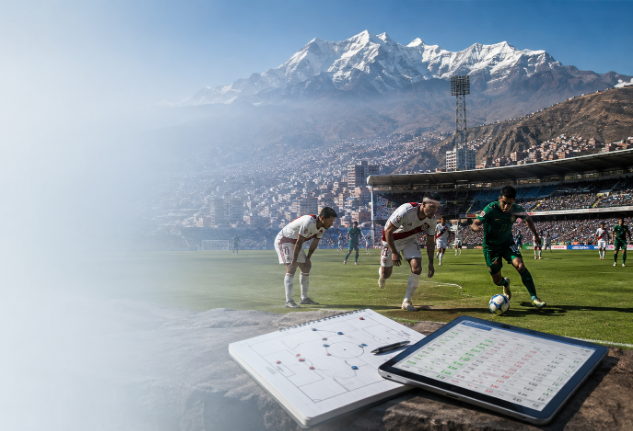
Every Copa Libertadores season, there’s a recurring storyline that has nothing to do with form, tactics, or transfer business: altitude. Visiting clubs – and the analysts trying to predict their results – arrive in La Paz knowing that Bolivia’s home advantage is built into the geography itself. For anyone following the Copa Libertadores closely, this is one of the clearest examples of a variable that standard form-based analysis simply doesn’t capture well.
This piece breaks down why altitude in La Paz is such a distinct challenge, how it tends to show up in match patterns, and what it means for anyone trying to read these fixtures with any real depth.
What Makes La Paz Different
La Paz sits at an elevation most footballers never train at. Estadio Hernando Siles, home to clubs like The Strongest and Bolivar, is situated roughly 3,600 meters above sea level – among the highest elevations of any top-flight football venue in the world. For context, that’s nearly four times higher than most elite stadiums across Europe and South America’s coastal cities.
At that altitude, the air is noticeably thinner, meaning less oxygen is available with every breath. For a visiting player used to sea-level or moderate-altitude conditions, this isn’t a minor adjustment – it’s a physiological shock that shows up almost immediately in match intensity, sprint recovery, and late-game decision-making.
Why the Body Struggles
Sports science generally agrees that unacclimatized athletes competing at extreme altitude experience reduced aerobic capacity, faster fatigue onset, and slower recovery between high-intensity efforts. In football terms, that translates to visiting teams often struggling to maintain their usual pressing intensity or sustain tempo in the final 20-30 minutes.
This is different from ordinary away-game fatigue. It’s not about travel schedules or unfamiliar pitches – it’s a measurable physical limitation that even elite conditioning can only partially offset without proper acclimatization time, which club schedules rarely allow for in a congested Copa Libertadores calendar.
How This Shows Up in Match Patterns
Analysts who follow the competition closely tend to notice a few recurring tendencies with La Paz fixtures, even without pinning exact figures to them:
- Home sides often start faster and press higher, capitalizing on their acclimatized fitness before the visiting team has fully adjusted.
- Visiting teams frequently look more comfortable in the opening stages than in the closing ones, as fatigue compounds in ways that wouldn’t happen at sea level.
- Away performances at altitude are often described by coaches and pundits as uncharacteristic – a technically strong side suddenly looking sluggish or error-prone by the hour mark.
None of this guarantees a particular scoreline or outcome. Plenty of visiting clubs have managed disciplined, well-organized performances in La Paz by prioritizing structure over intensity. But the pattern is common enough that it’s treated as a genuine tactical variable across South American football media, not just a talking point.
Why This Matters for Match Analysis
This is where altitude becomes genuinely useful information rather than trivia. Standard pre-match analysis – recent form, head-to-head record, squad news – doesn’t naturally account for a variable like elevation. A team that’s been in excellent form over its last five matches at sea level isn’t operating from the same baseline once it lands in La Paz.
Some practical things worth factoring in when analyzing these fixtures:
- Acclimatization time matters. Squads that arrive a few days early to adjust tend to look noticeably sharper than those flying in the day before kickoff.
- Squad depth and rotation policy matter more than usual. Coaches who understand the altitude challenge often make substitutions earlier than they would in a typical away fixture.
- Historical performance at altitude is a more relevant reference point than general away form. A club’s overall away record says less here than how it’s specifically performed in La Paz or comparable high-altitude venues like Quito.
This is also a good example of why football analysis benefits from looking beyond the surface-level form guide. The Copa Libertadores, more than most competitions, punishes bettors and analysts who treat every away fixture as functionally similar.
The Reverse Fixture Question
It’s worth noting the flip side too: does the altitude advantage disappear when Bolivian clubs play away from home? Broadly, yes – clubs based in La Paz often look less dominant away from Hernando Siles, which is consistent with the idea that much of their home strength is tied to opposition struggling with conditions rather than simply superior quality. This is a useful cross-check when evaluating how much weight to give a Bolivian side’s overall Libertadores form versus their specific home record.
Bringing It Together
Altitude in La Paz is one of the more concrete, well-understood variables in South American football, but it’s still just one factor among many. Squad quality, tactical setup, and matchday form all still matter – altitude changes the conditions those factors operate under, rather than replacing them entirely.
For anyone following the Copa Libertadores closely, treating altitude as a serious analytical variable – rather than an afterthought – is part of doing the homework properly. As with any football analysis, this kind of insight is useful for understanding match dynamics, not a basis for guaranteed predictions; outcomes in football remain genuinely uncertain, and any betting decisions should be made with that uncertainty in mind and within amounts you’re comfortable with.
FAQ
Why is La Paz considered such a difficult away venue in the Copa Libertadores?
Its extreme altitude – around 3,600 meters above sea level – reduces available oxygen, which measurably affects unacclimatized visiting players’ stamina and recovery during a match.
Do all visiting teams struggle at altitude in La Paz?
Not universally. Teams that arrive early to acclimatize and adjust their tactical approach have managed solid results, but sluggish second-half performances from visitors are a commonly noted pattern.
Does altitude give Bolivian clubs an advantage in every competition, or just at home?
The advantage is largely tied to the venue itself. Bolivian clubs playing away from La Paz generally don’t carry the same edge, since the altitude affects opponents rather than the home side’s underlying ability.